Blogaversary 2012

Twitter, Google Plus, Facebook, Flickr, 500px. pinterest on the horizon. All that’s missing is a partridge in a pear tree, and sometimes that appears to be there as well. The world of online communication and connection is pretty different that it was nine years ago, when I slapped a bunch of Python scripts onto a server running in a closet in my house. For all the other forms that have emerged, blogging still has a warm place in my heart. I’ve used this blog to host long (some might say too long) and short form content over the years. I never really mastered the short form content, so it was easy for that to migrate off into Twitter land. Some of the more personal stuff that I used to write has also gone to Twitter, or to a lesser degree Facebook, but there hasn’t been a lot of time for that, so most of it has gone by the wayside. What remains is the much longer form content. Unfortunately, firing up Ecto and writing a few dozen paragraphs doesn’t come easily, and getting over some of that inertia is what’s kept more content from appearing here.

Despite my initial misgivings, I like Google Plus. I like the ability to write short to medium content, as well as really nice picture support. I like how easy it is for conversations to start. I’m probably going to put a little more energy into being there. Will there be a 10th anniversary blog post in January 2013? I’m not sure. I’d like there to be, and I plan to keep on posting, but at the same time, there are only so many hours in a day.

2011 in Photography

I’ve been dreading writing the photography roundup post this year, because I haven’t taken a lot of photographs. I’ve only a few months worth of photographs on Flickr, which makes a month by month roundup pretty tough to do.   We’ve had an enormous amount of stuff going on schedule wise this year, and between all of that activity, and me getting fussier about my pictures, 2011 saw a precipitous decline in the average number of pictures that I made during a given month.

I’m still doing some dance performance work,

OPG Nutcracker 2011

OPG Nutcracker 2011

OPG Nutcracker 2011

OPG Nutcracker 2011

Bainbridge Ballet Recital 2011

Bainbridge Ballet Recital 2011

Bainbridge Ballet Recital 2011

Bainbridge Ballet Recital 2011

and on the right occasions, I am going to interesting places that yield interesting pictures

SXSW Interactive 2011

SXSW Interactive 2011

_SXSW Interactive 2011

The highlight of the year for me photographically was a project that I did with one of the seniors at my daughters’ dance studio

Liza

Liza

Liza

Liza

Liza

Liza

Liza

I think that the other notable thing for me and photography in 2011 is a move away from Flickr and towards Google+, Facebook, and 500px. This is definitely a bittersweet thing for me. Flickr is pretty much responsible for getting me back into photography and putting me on a good track of growth. At the same time, I see Flickr weakening in various ways. I do a limited amount of portrait/dance shooting in my local area. For this kind of work, Facebook is pretty much the place where people might see my work. When Google+ burst onto the scene earlier this year, it was clear that it was really pretty decent for photography, and a lot of professional and advanced amateur photographers have taken to the service. In particular, Google+’s hangouts feature is great for photography growth. There are amazing photographs and photographers on Flickr, but if you look at 500px, the level of photography being displayed there is pretty amazing. I’m going to keep using Flickr, I think, but I’m going to be shifting more of my energy to Google+ and 500px in 2012.

One of the big happenings in 2011 was that we did a remodel of the empty bonus room that’s over our garage. One of the use cases for the design of that remodel was as a photo studio. Due to time, I haven’t really been able to get up there much, but I hope to spend some time working there come the new year, so perhaps next year’s roundup won’t be so lean.

Book Review: Head First HTML5 Programming

You can’t read about modern web development without hearing something about HTML5. It is a term that covers not only the next version of the HTML markup language, but a broad array of facilities exposed as JavaScript API’s. Eric Freeman and Elisabeth Robson’s new book Head First HTML5 Programming approaches HTML5 from this point of view, and uses the friendly, pictorial style of their highly successful Head First Design Patterns.

You’ll need an understanding of HTML and CSS before you dive in. This book assumes that you have those technologies under your belt, and starts right in with JavaScript. The first four chapters of the book are a good introduction to JavaScript, the web browser Document Object Model (DOM), event handling and objects. This ensures that you’ll have the level of JavaScript knowledge necessary for the chapters to come. And you will need it. In the remaining six chapters, the book covers the use of Geolocation, AJAX with JSON, including JSONP, the Canvas tag, the video tag, the various Web Storage API’s, and Web Workers. Each chapter teaches you about its subject material by building a decent size application in JavaScript. I think that seeing how an application will use a feature is the best way to really learn about it.   

If you’ve been wondering about the new features in HTML5, this book is a good introduction. The authors have stuck to the parts of HTML5 that are pretty well defined, and stayed away from those parts of the standard that are still changing. The Head First style presents you with the material from many different angles, which helps to make sure that your brain holds onto it.

One of my daughters is interested in web programming. She needs just a little more CSS learning and then she’ll be ready to step up to dynamic HTML / HTML5. When she is, I’ll be handing her a copy of this book.

Disclosure: Both the authors of Head First HTML5 are friends, and Eric Freeman used to be my boss at Disney.

Clojure Conj 2011

Last week I was in Raleigh, attending the second Clojure/Conj. The last time that I attended a Lisp conference was the 1986 ACM Conference on Lisp and Functional Programming. I am a Lisp guy. I took the famed “Structure and Interpretation of Computer Programs” course from Sussman and Abelson. I spent some time doing undergraduate research on Symbolics Lisp Machines. When Apple invested some energy into Dylan, I hoped that I’d be able to use a Lisp on a personal computer. Java pretty much ruined that. Over the years, I pretty much gave up on the idea of being able to use Lisp for my day to day work. So much so, that when I first heard Rich Hickey talk about Clojure, my reaction going in was unenthusiastic. By the end of Rich’s talk, he had my attention. Clojure has been doing some growing up since then, and I really wanted to attend last year’s Clojure/Conj, but wasn’t able to.

Almost all of my conversations at the conference involved the questions, “Why are you at Clojure/Conj” and “How did you get interested in Clojure”. I’ve answered the second question in the previous paragraph. The question of “why” boils down to three themes: Clojure itself, Data, and Clojurescript. I’m going to use these threes theme to report on the conference talks.

Clojure itself
Clojure is a Lisp dialect that runs on the JVM and has great interoperability with existing Java code. It has great support for functional programming, as well as several innovative features for dealing with concurrency.

Stuart Sierra started off with a talk that pointed out areas where people could learn beyond the books and online exercises that are available. In each of those areas, he also proposed projects that people could work on. One of the things that stood out for me was his use of the Clojure reader to deal with Java Resources. I always found Resources to be annoying, and the use of the Reader is a clever way to make them more palatable and useful.

Clojail is a system for executing Clojure code in a sandbox. The system is quite flexible and the applications aren’t just limited to security. I can imagine using clojail to implement something like the Sponsors described in the original Actor model. Anthony Grimes, one of the committers for clojail gave the presentation. He is 17 years old.

One thing that made me happy was to see the bridge building between the Scala and Clojure communities. Phil Bagwell, who pioneered many of the persistent data structures in Clojure is now at Typesafe, the Scala company. He came and gave a nice talk about Scala’s parallel collection classes. Perhaps these classes will one day find their way into Clojure Daniel Spiewak gave a very solid presentation on the computer science behind the persistent data structures in Clojure.

At many conferences a talk like Clojure on Android would be at the higher end. The technical level of the talks at the Conj was high enough to make the task of getting Clojure on Android seem mundane. This is to take nothing away from the very impressive work that has been done. There are some issues remaining like footprint and startup time, but it looks like some effort is going to happen at the Clojure core team level to make some of this possible. The thought of talking to a REPL running on a phone, or tablet is a tasty one.

Rich Hickey’s keynote reminded me very much of a Guido keynote at PyCon: a discussion of language issues that he was looking at, and a solicitation for discussion. Rich was very careful to say that the stuff he was discussing was not a roadmap, so I’ll repeat that disclaimer. Here are some of the items that stood out to me. Plans to allow multiple builds of Clojure – a regular version, a leaner deployment version, a really lean Android version, a super deluxe development/debugging version and so on. There is discussion about allowing the reader to be extensible, in order to allow new data types to be round tripped. I didn’t follow the history of ClojureScript, so it was useful to see that Rich is pretty committed to this idea, and that bits of technology might even be flowing “backward” from the ClojureScript compiler into Clojure on the JVM. I was also very interested on Rich’s view that the use of a logic system like that in core.logic would be a far better tool than a traditional type system. More on the logic system below.

The last talk of the conference was Sam Aaron’s talk on Overtone, which is a computer music system written in Clojure. The major point was that he used Clojure to define a language for describing computer music, much in the sam way that sheet music describes regular music. There was lots of cool music along the way, including a pretty good simulation of the sound portion of the THX commercial that often plays before movies. The description of that commercial fit in a single projected screen of code.

Data

One thing that I’ve been looking at recently is exploratory environments for working with “federated” data. I’ve grown to dislike the term Big Data, because it’s come to mean almost nothing, however, the ship has already sailed on that one. Most people would be familiar with the idea of sitting down in front of their relational database SQL command prompts, and issuing ad-hoc queries. As the use of varied kinds of storage systems grows, we are losing that kind of interactive relationship with data. Some of the people in the Clojure community have built some interesting data systems, and Clojure is itself amenable to exploratory work with data, between it’s orientation around functional programming, and a development style oriented around a REPL.

David McNeil talked about Revelytix’s federated (among RDBMS and RDF triple store) SPARQL query engine. Their system uses s-expressions to represents the nodes in a graph of stream processing nodes. These expressions are then compiled down to a form that can be executed in parallel using the Java Fork/Join framework. The operators in the s-expessions are mirrors of built in Clojure sequence functions, and can use and be used in Clojure expressions. It’s not hard to imagine extending the set of federatable storage systems.

Heroku’s Mark McGranaghan talked about viewing logs data. What he really meant was viewing log data as akin to a native data type on Clojure and being able to use Clojure’s built in functions on log data in a natural way. Heroku has built a system call Pulse which takes this view. I particularly liked the small functions that he defined for expressing the intervals for recomputing statistics. It’s the cleanest formulation of that kind of thing that I’ve seen, and it’s enabled by his thesis view and Clojure.

Nathan Marz has been doing some great work at BackType and now Twitter. At StrangeLoop he open sourced Storm, a set of general primitives for doing realtime computation. At the Conj, he was talking about Cascalog, which is a Clojure DSL for Hadoop. Both Cascalog and Storm are in use at Twitter. Cascalog is inspired by Datalog and targets the same space as Pig. Cascalog has the full power of Clojure available to it, as well as the power of Datalog. It’s a little unclear to me exactly how much of Datalog is supported, but this is a powerful idea. Imagine combining the best of Cascalog and the Revelytix system. The source code to Marz’s examples is on Github.

Clojure has a logic programming library, core.logic which is based on the miniKanren system developed at Indiana University by Daniel Friedman, William Byrd, and Oleg Kiselyov. Ambrose Bonnaire-Sergeant presented an excellent tutorial on logic programming in general, and miniKanren in particular. David Nolen talked about predicate dispatching, a much more general way of doing method dispatch, and talked about his plans to tie that together with core.logic. The surprise highlight in this area was that Dan Friedman and William Byrd came to the conference and did a BOF on miniKanren and their constraint extensions to miniKanren. The BOF was surprisingly well attended (over 60 people), due in part to Ambrose’s excellent talk earlier that day. A key philosophical point about miniKanren is that there is a straight forward mechanical conversion from a functional program to logical/relational (miniKanren) program. This looks very promising, and it has me thinking about mashups of miniKanren (core.logic) and Datalog (cascalog). Professor Friedman and his students have done some very important work in the Scheme area over the years, and it was a great experience to meet him and spend some time over dinner. After dinner, we were sitting in the hotel lobby, and David Nolen was walking Friedman and Byrd through the implementation of core.logic, which was ported from the Scheme version of miniKanren, and then optimized for Clojure. There was a free flow of ideas back and forth, and it was a great example of a collaboration between academia and practice (it’s hard to say industry because Nolen and company are doing this in their free time). This is one of the things that I’ve always hoped for around open source, and it was nice to see such a concrete example. MiniKanren is described in Byrd’s PhD dissertation, and in the book “The Reasoned Schemer“.

ClojureScript

ClojureScript is a Clojure compiler which emits Javascript, which is then run though Google’s Closure compiler. I’ve been doing some prototyping work using Node.js and HTML/Javascript, so ClojureScript looks kind of interesting, particularly because it is good at some the data intensive stuff that Javascript is so laborious at. There were three ClojureScript sessions. Chris Houser took us on a deep dive of the compiler, Kevin Lynagh show us some basic applications of ClojureScript in the browser, and David Nolen did a BOF where he showed off the browser connected REPL for Javascript. ClojureScript is still in its infancy, but it’s interesting nonetheless. Once David gets the constraint version of core.logic working in ClojureScript, it should get a lot more interesting.

Community

The thing that stood out to me about the Clojure community was the presence of the “young Jedi”, Anthony Grimes, and Ambrose Bonnaire-Sergeant. Both of them were able to attend their first Clojure/Conj (Anthony’s was last year) due to fundraising campaign initiated by Chas Emerick. Anthony is 17, and Ambrose has not yet graduated from college. Both of them are lead developers on highly technical projects within the Clojure community, and both did a great job of speaking in front of 300+ people who were mostly older than them. When I worked at OSAF, I worked with Stuart Parmenter, who started working in open source when he was 14. It’s great to work with these young, very gifted people, and I love seeing the community welcome and make a space for them.

The flip side of this is that like many open source, programming language oriented conferences, there were very few women in attendance. Perhaps the Clojure community could take a page from the very successful work that my friend Sarah Allen has done on RailsBridge.

Learning More

O’Reilly has finally recanted and is doing a Lisp book. Clojure Programming should be done soon, and Manning has Clojure in Action and The Joy of Clojure. If you are looking for an interactive way of learning Clojure, there is Try Clojure. Those looking to sharpen their Clojure skills can look at the Clojure Koans and 4Clojure .

The speaker slides from the Clojure/Conj 2011 are available on GitHub.

Update: corrected the name of Indiana University – thanks to Lindsey Kuper

Update: linked to a more up to date Overtone repository – thanks to Sam Aaron

Web 2.0 Summit

Last week I attended the Web 2.0 Summit in San Francisco. The theme this years was “The Data Frame”, an attempt to look at the “Points of Control Theme” from last year through the lens of data.   

Data Frame talks

Most of the good data frame stuff was in the short “High Order Bit” and “Pivot” talks. The interviews with big company CEO’s are generally of little value, because CEO’s at large companies have been heavily media trained, and it is rare to get them to say anything really interesting.

Genevieve Bell from Intel posed the question “Who is data and if it were a person what would it be like?” Her answers included:

  • Data keeps it real – it will resist being digitized
  • Data loves a good relationships – what happens when data is intermediated
  • Data has a country (context is important)
  • Data is feral (privacy security,etc )
  • Data has responsibilities
  • Data wants to look good
  • Data doesn’t last forever (and shouldn’t in some cases)

One Kings Lane was one of the startups described by Kleiner Perkins’ Aileen Lee. The interesting thing about their presentation was their realtime dashboard of purchasing activity during one of their flash sales events. You can see the demo at 6:03 in the video from the session.

Mary Meeker has moved from Morgan Stanley to Kleiner Perkins, but her Internet Trends presentation is still a tour de force of statistics and trends. It’s interesting to watch how her list of trends is changing over time.

Alyssa Henry from Amazon talked about AWS from the perspective of S3, and her talk was mostly statistics and customer experiences. One of her closing sentences stuck in my mind: “What would you do if every developer in your organization had access to a supercomputer”. Hilary Mason has talked about how people in sitting at home in their pajamas now have access to big data crunching capability. Alyssa’s remark pushes that idea – pushing the thought that access to supercomputing resources is at the same level as access to a personal computer.

TrialPay is a startup in the online payment space. Their interesting twist is that they will provide payment services free of charge, without a transaction fee. They are willing to do this because they collect the data about the payment, and can then use / sell information about payment behaviors and so on (apparently Visa and Mastercard plan to do something similar).

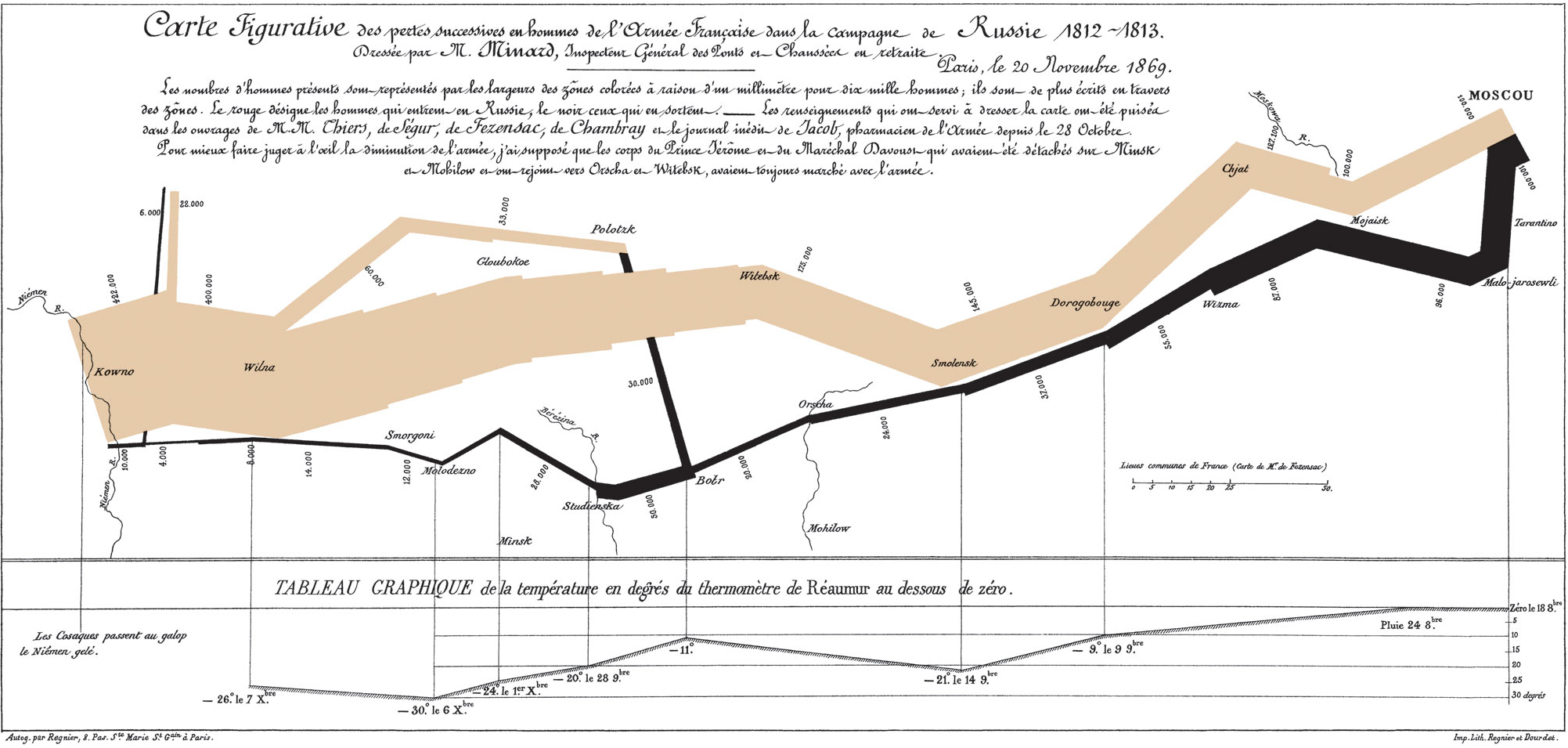
I am not a fan of talks that are product launches or feature launches on existing products, so I was all set to ignore Susan Wojcicki’s talk on Google Analytics. But then I saw this picture in her slides:

Edward Tufte has made this diagram famous, calling it “probably the best statistical graphic ever drawn”. I remember seeing this graphic in one of his seminars and wondering how to bring this type of visualization to a computer. I appreciated the graphic, but I wasn’t sure how many times one would need to graph death marches. The Google Analytics team found a way to apply this visualization to conversion and visitor falloffs. Sure enough, those visualizations are now in my Google Analytics account. Wojcicki also demonstrated that analytics are now being updated in “real time”. Clearly, there’s no need to view instant feedback from analytics as a future item.

Last year there was a panel on education reform. This year, Salman Khan, the creator of the Khan academy spoke. Philosophically I’m in agreement with what Khan is trying to do – provide a way for every student to attain mastery of a topic before moving on. What was more interesting was that he came with some actual data from a whole school pilot of Khan Academy materials. Their data shows that it is possible for children assigned to a remedial math class to jump to the same level as students in an advanced math class. They have a very nice set of analytic tools that work with their videos, which should lead to a more data based discussion of how to help more kids succeed in learning what they need to learn to be successful in life.

Anne Wojcicki (yes, she and Susan are sisters) talked about the work they are doing at 23andMe. She gave an example of a rare form of Parkinson’s disease, where they were able to assemble a sizable number of people with the genetic predisposition, and present that group to medical researchers who are working on treatments for Parkinsons. It was interesting story of online support groups, gene sequencing, and preventative medicine.

It seems worth pointing out that almost all the talks that I listed in this section were by women.

Inspirational Talks

There were some talks which didn’t fit the data frame theme that well, but I found them interesting or inspirational anyway.

Flipboard CEO Mike McCue made an impassioned plea that we learn when to ignore the data, and build products that have emotion in them. He contrasted the Jaguar XJSS and the Honda Insight as products built with emotion and built on data, respectively. He went on to say that tablets are important because the content becomes the interface. He believes that the future of the web is to be more like print, putting content first, because the content has a soul. Great content is about art, art creates emotion, and emotion defies the data. It was a great, thoughtful talk.

Alison Lewis from Coca Cola talked about their new, high tech, internet connected Freestyle soda machine. A number of futuristic internet scenarios seem to involve soda machines, so it was interesting to hear what actual soda companies are doing in this space. The geek in me thinks that the machine is cool, although I rarely drink soft drinks. I went to the Facebook page for the machine to see what was up, and discovered that the only places in Seattle that had them were places where I would never go to eat.

IBM’s David Barnes talked about IBM’s smart cities initiative, which involves instrumenting the living daylights out of city. Power, water, transportation grid, everything. His main points were:

  1. Cities will have a healthier immune systems.  The health web
  2. City buildings will sense and respond like living organisms – water, power, etc systems
  3. Car and city buses will run on empty..
  4. Smarter systems will quench cities thirst and save energy
  5. Cities will respond to a crisis – even before receiving an emergency call

He left us with a challenge to “Look at the organism that is the city.  What can we do to improve and create a smarter city?”. I have questions about how long it would take to actually build a smart city or worse, retrofit an existing city, but this is a challenge type of long term project. I’m glad to see that there are companies out there that are still willing to take that big long view.

Final Thoughts

I really liked the short talk formats that were used this year. It forced many of the speakers to really be crisp and interesting, or at least crisp, and I really liked the volume of what got presented. One thing seems true, that from the engineering audience of Strata to the executive audience at Web 2.0, data and data related topics are at the top of everyone’s mind.

And there in addition to ponies and unicorns, be dragons.

Surge 2011

Last week I was in Baltimore attending OmniTI’s Surge Conference. I can’t remember exactly when I first met OmniTI CEO Theo Schlossnagle, but it was at an ApacheCon after he had delivered one of his 3 hour tutorials on Scalable Internet Architectures, back in the early 2000′s. Theo’s been at this scalability business for a long time, and I was sad to have missed the first Surge, which was held last year.

Talks

Ben Fried, Google’s CIO started the conference (and one of the major themes) with a “disaster porn” talk. He described a system that he built in a previous life, for a major wall street company. The system had to be very scalable to accommodate the needs of traders. One day, the system started failing, and ended up costing his employer a significant amount of money. In the ensuing effort to get the system working again, he ended up with all the people from the various specializations (development, operations, networking, etc) all stuck in a very large room with a lot of whiteboards. It turned out that no one really understood how the entire system worked, and that issues at the boundaries of the specialties were causing many of the problems. The way that they had scaled up their organization was to specialize, but that specialization caused them to lose an end to end view of the system. Their organization of their people had led to some of the problems they were experiencing, and was impeding their ability to solve the problems.   The quote that I most remember was “specialization is an industrial age notion and needs to be discounted in spaces where we operate at the boundary of the known versus unknown”. The lessons that Fried learned on that project have influenced the way that Google works (Site Reliability Engineers as an example), and are similar to the ideas being espoused by the “DevOps” movement. His description of the solution was to “reward and recognize generalist skill and end to end knowledge”. There was a pretty lively Q&A around this notion of generalists.

Mark Imbriaco’s talk was titled “Anatomy of a Failure” in the program, but he actually presented a very detailed account of how Heroku responds to incidents. My background isn’t in operations, so I found this to be pretty interesting and useful. I particularly liked the idea of playbooks to be followed when incidents occur, and that alert messages actually contain links to the necessary playbooks. The best quote from Mark’s talk was probably “Automation is also a great way to distribute failure across an entire system”.

Raymond Blum presented the third of three Google talks that were shoe horned into a single session. He described the kind of problems involved in doing backups at Google scale. Backup is one of those problems that needs to be solved, but is mostly unglamourous. Unless you are Google, that is. Blum talked about how they actually read their backup tapes to be sure that they work, their strategy of backing up to data centers in different geographies, and clever usage of map reduce to parallelize the backup and restore process. He cited the Gmail outage earlier this year as a way of grasping the scale of the problem of backing up a service like GMail, much less all of Google. One way to know if a talk succeeds is if it provokes thoughts. Based on my conversations with other attendees, this one succeeded.

David Pacheco and Bryan Cantrill talked about “Realtime Cloud Analytics with Node.js”. This work is an analog of the work that they did on the analytics for the “Fishworks”/Sun Storage 7000 products, except instead of measuring a storage appliance, they are doing analytics for Joyent’s cloud offering. This is basically a system which talks to DTrace on every machine, and then reports the requested metrics to an analytics service once a second. The most interesting part of the talk was listening to two guys who are hard core C programmers / kernel developers walk us through their decision to write the system in Javascript on Node.js instead of using C. They also discussed the areas where they expected there to be performance problems, and were surprised when those problems never appeared. When it came time for the demo, it was quite funny to see one of the inventors of DTrace being publicly nervous about running DTrace on every machine in the Joyent public cloud.   ”Automation is also a great way to distribute failure across an entire system”. But everything was fine, and people were impressed with the analytics.

Fellow ASF member Geir Magnusson’s talk was named “When Business Models Attack”. The title alludes to the two systems that Geir described, both of which are designed specifically to handle extreme numbers of users. Geir was the VP of Platform and Architecture at Gilt Groupe, and one description of their model is that every day at Noon is Black Friday. So the Gilt system has to count on handling peak numbers of users every day at a particular time. Geir’s new employer, Function(x), also has a business model that depends on large numbers of users. The challenge is to design systems that will handle big usage spikes as a matter of course, not as a rarity. One of architectures that Geir described involved writing data into a Riak cluster in order to absorb the write traffic, and then using a Node.js based process to do a “write-behind” of that data into a relational database.

Takeaways

There were several technology themes that I encountered during the course of the 2 days:

  • Many of the talks that I attended involved the use of some kind of messaging system (most frequently RabbitMQ). Messaging is an important component in connecting systems that are operating a different rates, which is frequently the case in systems operating at high scale.
  • Many people are using Amazon EC2, and liking it, but there were a lot of jokes about the reliability of EC2.
  • I was surprised by how many people appear to be using Node.js. This is not a Javascript or dynamic language oriented community. There’s an inclination towards C, systems programming, and systems administration. Hardly an audience where you’d expect to see lots of Node usage, but I think that it’s notable that Node is finding some uptake.

One thing that I especially liked about Surge was the focus on learning from failure, otherwise known as a “fascination with disaster porn”. Most of the time you only hear about things that worked, but hearing about what didn’t work is at least as instructive, and in some case more instructive. This is something that (thus far) is unique to Surge.

W3C Web and TV Workshop

Last week I attended the Third W3C Web and TV Workshop (disclosure: I was a member of the program committee). This was the third in a series of three workshops that the W3C has organized around the intersection of web technologies and television. The purpose of the workshops is to bring these two communities together and help them understand and work with each other. The W3C has formed an interest group for member companies who are interested in working on issues related to the web and television.

Some of the topics discussed at the workshop included multi-screen experiences (there were 2.5 sessions on this topic, including some demonstrations), synchronized metadata, codecs (particularly around adaptive bit rate streaming over HTTP), and (inevitably) content protection/DRM.   

Given the advent of the iPad and other tablets, it should be no surprise that multi-screen experiences were a big topic. Apple has done some interesting work with AirPlay, but the general technology infrastructure for enabling multi-screen experiences is a mess. There are issues ranging from the “bottom”, related to the discovery of the various devices, through the negotiation of which devices have which roles, up to the mechanism for synchronizing content and metadata amongst these devices. There’s a lot of work to be done here, and some of that will be done in conjunction with other industry groups like DLNA and so forth. I’m most interested in the upper levels, which should be helping with synchronizing the experience and facilitating inter device/application communication.   

There was also significant discussion around synchronized metadata, which is highly relevant to multi-screen experiences, although there was more discussion/demonstration of end experiences as opposed to technologies that could be standardized to facilitate those experiences. Sylvia Pfeiffer gave an interesting demo of WebVTT using the Captionator polyfill. One of the best things about this discussion was that one of my colleagues from ESPN later explained to me the details of how captioning is done in their broadcast and internet workflows.

It’s impossible to talk about television without talking about video, and the two largest topics around video and the web are codecs and content protection. Most of the discussion around codecs revolved around the work at MPEG on Dynamic Adaptive Streaming over HTTP (DASH). There are at least three solutions in the market for streaming video via HTTP, all mutually incompatible for dumb reasons. DASH is an attempt to standardize that mechanism, while remaining silent on the question of which codec is used to produce the video file being streamed.

On the content protection front, there was the usual disconnect between the web world and the tv world. For me, the discussion here really centers around the ability to use the HTML5 video tag to deliver “premium” content. Today that content is delivered via the object tag and associated browser plugins. The problem is that each plugin works differently, so your web application code has to deal with all the possibilities that it might encounter. There appears to be some interest in standardizing a small and narrow set of API’s that web applications could use to interact with a content protection mechanism. Unsurprisingly, there was very little interest in standardizing a content protection mechanism for HTML5, especially since there isn’t agreement on a standard video codec.

Recently the W3C has been working very hard at getting consumer/content side companies to participate in its activities. Because the workshop was open to anyone, not just W3C member companies, there were a lot of attendees who were not from the traditional W3C constituencies. Personally, I think that this is a good thing, and not just in the Web and TV space. It will be interesting to see how much progress can be made – the Apple and Google native application models, are this generation’s Flash and Silverlight. I hope that we can find a way to build the next generation of television experiences atop the Open Web technology stack.

Thanks, Steve

Yesterday, Steve Jobs resigned as the CEO of Apple. This wasn’t really a surprise, because Steve has been sick for some time. Nonetheless, it was a shock to me, and judging by Twitter, to many other people.   

My history with computing goes back to the Apple II. The first computer that I ever wrote a program on was an Apple II, and an Apple II was the first computer I ever owned. It was in the days when nobody really knew if a personal computer was a practical notion at all. It’s easy to look at the myriad forms of “personal computers” that we use today, and forget that. Before I became interested in computers, I was going through serious interests or hobbies at the rate of one a year. I locked onto computers with a passion, one that was undivided until I took up photography several years ago. Apple, more than any other company, inspired me about computing – what computers might do for people, how they should work. I imbibed the Apple philosophy – I “bled six colors”.   

It was one of my childhood dreams to work at Apple, and I was fortunate to work on the Newton for two years. I was at Apple when Apple bought NeXT, and when Steve took over the company from the inside. When the Newton team had meetings with Steve (before he cancelled the project), I was amazed at how much sense he was making. The respect I had developed from afar turned into respect developed from actual experience. I felt that if anyone could fix Apple’s woes, Steve was the one to do it. I just didn’t believe that anyone was going to be able to do it, so I left. How glad I am that I was wrong.

For me, Apple has always been more than just a company that makes great products (because in those dark days, some of the products were quite bad). Apple has been the embodiment of a particular vision of how computers should be, and Steve Jobs was the person that drove that vision and inspired many in my generation to get interested in computing. No company or person can be perfect, and both Apple and Steve Jobs have easily identifiable flaws, but the vision that Apple represents has driven dramatic improvements in computing since 1977.

Thank you Steve for being the torch bearer, and for the impact that you’ve had on my life, and on the world.

OSCON 2011

I’m sitting on an Amtrak train at the end of July, which can only mean that OSCON has just finished up.

This year OSCON had something new, a pair of extra conferences, one on Data and one on Java, that overlapped the usual OSCON tutorial days. This year, I’m going to break the talk coverage down by conference.

OSCON Data

For purely technical content, OSCON Data was the winner for me. There were two talks which stuck out.   

The first was Tom Wilkie’s talk on Castle. I first became aware of Castle at South by Southwest, when a persistent Manu Marchal found me on Twitter and arranged a meeting to explain the technology that Acunu was building to accelerate Cassandra and similar types of storage engines. Earlier this year the Acunu team published some papers describing their work. Those papers are still on the desk in my office, so I figured I could get the overview of the paper content by attending the talk. It’s a pleasure to see a talk focused on fundamental technology work on data structures and algorithms, and Tom’s talk delivered that. Castle is the open source version of their write optimized in kernel storage system. I’m looking foward to hearing field reports.

The other stand out talk was Josh Patterson’s talk Lumberyard: Time series indexing at scale, Time series data is growing in importance, and it’s great to see people working on this problem. Lumberyard uses the iSAX work that was done at UC Riverside. In addition to the time series functionality, Josh demonstrated how a number of seeming unrelated problems like image recognition, could be converted into time series problems which could then be solved with something like Lumberyard. I definitely learned something new.

OSCON Java

I only attended one talk at OSCON Java, and then only briefly. The talks was a keynote on JavaFX. JavaFX was originally positioned as a competitor to Flash/Flex, and then expanded to act as a new GUI framework for desktop Java. In the meantime, the world has moved. The iPad is casting doubts on the value proposition of Flash, which is an established and broadly adopted technology. Microsoft is backing away from Silverlight, and focusing on HTML5. Even if Oracle wins its lawsuit with Google it’s hard to see how JavaFX would be relevant for the device world.   It’s hard to see how there is any room for JavaFX.

OSCON

Ariel Waldman was given a keynote slot to talk about Hacking Space Exploration. Space exploration is a topic that resonates with many people that come to OSCON, and given the recent end of the U.S. Space Shuttle program, it was encouraging to hear about all the avenues which are available to those who are interested in space exploration. My middle daughter wants to go to Mars someday, and I’m definitely going to be showing her the video of this talk.

I ended up in Gabe Zicherman’s talk on Gamification by accident. Late last year we sent someone from our group to a gamification workshop and Zicherman was among the speakers. I figured that via summarized analysis I had heard all that I needed to know. Apparently not. The material that was presented was thought provoking, and Zicherman is an effective and entertaining speaker.   

Personal information is in my blood, from my time working on Chandler and well before that.   When I was at Strata last year, I briefly heard about the Locker project, but I didn’t really get a good sense of what was going on there. Jeremie Miller partially talked about and partially demo’ed the Locker project, and there was also a hackathon during one of the BOF slots. It is very early days still, but if you are interested in getting involved, bootstrapping instructions are here.

Sometimes you find emerging technology in the strangest places. I went to Awakening The Maker Ethic in K-12 Students because it was the only talk in that slot that seemed interesting, because I have kids, and because we’ve pursued an unusual path for their education. In addition to amassing a long reading list on education and technology and education, I learned something interesting about open hardware, Arduino in particular. Arduino has been around for a while, but I’ve really only heard it mentioned in the context of communities that would be the logical extensions of the model rocketeers, the hams, and the heathkit crowd. During this talk I learned that Arduino has crossed over into communities that are focused more on craft and art. Arduino makes it possible for these people to make smart craft items. Some examples of such items are this “reverse geocache” wedding gift box, and a bicycling jacket with turn signal lights embedded in it.

Hallway

I try not to comment on the hallway track, but there’s one conversation that i had which I think merits an mention. Earlier in the year, some mutual friends introduced me to David Eaves, who has been consulting with Mozilla to develop some metrics to help Mozilla improve the way that it manages its community. In April, David previewed some of his work in a blog post. At the ASF various individuals have done small experiments around community metrics, but as far as I can tell David’s work is defining the state of the art in this area. I would love to see the work that he has been doing duplicated in JIRA and Github. This is the kind of work that should be a talk at OSCON, and it’s a shame that we’ll have to wait until next year to hear that talk. In the meantime, read the post, get on the mailing list, and help bring open source community tools into the 21st century.

Meta

I’ve been coming to OSCON since 2003 (I did miss one year), and I always look forward to it. This year OSCON was tough for me. I had a very difficult time finding sessions to go to, especially in OSCON proper. Of the four sessions I found blog worthy, two were about open source, and I only ended up in two of them by accident – I almost went to nothing during those sessions. Ordinarily, that wouldn’t be a problem, because there’s always the hallway track. This year a lot of people that I normally expect to see at OSCON were not there. I did have a good hallway track, but not nearly as rich as normal. As an example, some of us went to celebrate Duncan Davidson’s birthday on Thursday night. In the past, there have been enough people to take over the Vault in Portland. This year, we only needed a single table. For me, that’s a serious impact because of the way that I approach the technology field. When I was a graduate student, my advisor lamented about a bygone era of DARPA funding in which you would go to DARPA and say, “I’m going to do X”. Sometimes you came back with X, but sometimes you came back with Y, but as along as Y was interesting there wouldn’t be a problem. During my era, DARPA apparently got much more serious about you doing what you said you would do. In that bygone era, DARPA funded people. In my era, they funded topics. Topics are important to me, but given the choice between topics and people, I will pick the people every time. I always tell people that the value of OSCON is that it’s the one place where you can get any substantial number of the open source communities together under one roof. I hope that keeps happening.

Google I/O 2011

Google I/O has a different feel than many of the conferences that I attend. Like Apple’s WWDC, there is a distinctly vendor partisan tone to the entire show — having the show in the same location as WWDC probably reinforces that. Unlike WWDC, the web focused portion of Google I/O helps to blunt that feeling, and the fact that lots of things are open or being open sourced also helps with the partisan feeling.

I’m going to split this writeup into two parts, the two keynotes, and the rest of the talks.

Android Keynote

The first keynote was the Android keynote and opened with a recap of Android’s marketplace accomplishments over the last year. The tone was decidedly less combative towards Apple than last year. There weren’t many platform technology announcements. There was the expected discussion of features for the next version of Android, but I didn’t really see much that was new. There was a very nice head tracking demo that involved front facing cameras and OpenGL – I believe this will be a platform feature, which is cool. Much was made of Music and Movies, but this is mostly an end user and business development story. The ability to buy/stream without a cable is nice, but as long as devices need to be plugged in to recharge (which in my case is every day), I don’t find this to be as compelling as those who were clapping loudly. What I did find interesting was the creation of a Council that will specify how quickly devices will be updated to a particular release of Android, and how long a device will be supported. This is pretty much an admission that fragmentation is real and a problem that needs addressing. I hope that it works.

The most interesting announcement during the Android keynote was the open accessories initiative. This is in direct contrast to Apple’s tight control over the iOS device connector. Google’s initiative is based on the open source Arduino hardware platform, and they showed some cool integration with an exercise bike, control over a home made labyrinth board, and some very interesting home automation work. As part of the home automation stuff, they showed an NFC enabled CD package being swiped against a home audio device, which then caused the CD to be loaded into the Google music service. This is cool, but I don’t know if CD’s will be around long enough for NFC enabled packaging to become pervasive. I’m very curious to see how the accessories initiative will play out, especially versus the iOS device connector. If this were to take off, Apple could build support for the specs into future iOS devices, although they would have to swallow their pride first. This will be very interesting to watch.

Chrome Keynote

Day two’s keynote was about Chrome, and the open web, although the focus was on Google’s contributions. Adoption of Chrome is going really nicely – 160M users. There was a demonstration of adding speech input by adding a single attribute to an element (done via the Chrome Developer Tools). Performance got several segments. The obligatory Javascript performance slide when up, showing a 20x improvement since 2008, and the speaker said he hoped to stop showing such slides, claiming that the bottlenecks in the system were now in other parts of the browser. This was a perfect segue to show hardware accelerated CSS transforms as well as hardware accelerated Canvas and WebGL.

I’ve been curious whether the Chrome web store is really a good idea or not, and we got some statistics to ponder. Apparently people spend twice as much time in applications when they are obtained via the web store, and people perform 2.5x the number of transactions. I wish there were some more information on these stats. Of course this is all before in-app purchasing, which was announced, along with a very small 5% cut for Google.   

Of course, no discussion of an app store should be without a killer app, so Google brought Rovio onto the stage to announce that Angry Birds is now available for the web, although it’s called Angry Birds for Chrome, and has special levels just for Chrome users. Apparently Chrome’s implementation of Open Web technologies has advanced to the point where doing a no compromises version of Angry Birds is possible.   Another indication of how far the Open Web has come is “3D dreams of Black“, which is a cool interactive media piece that is part film, part 3d virtual world. I’m keeping a pretty close eye on the whole HTML5 space, but this piece really shows how the next generation of the web is coming together as a medium all its own.

The final portion of the keynote was about ChromeOS and the notebooks or “Chromebook”s that run it. A lot of the content in this section was a repeat of content from Google’s Chrome Update event in December, but there were a few new things. Google has been hard at work solving some of the usage problems discovered during the CR-48 beta. This includes the trackpad (which was awful), Movies and Music, local file storage, and offline access. The big news for I/O is that Google has decided that ChromeOS is ready to be installed on laptops which will be sold as “Chromebooks”. Samsung and Acer have signed up to manufacture the devices. Google will also rent Chromebooks to businesses ($28/mo per user) and schools ($20/mo per user). This is latest round of the network computer vision, and it’s going to be interesting to see whether the windows of technology readiness and user mindset are overlapping or not. The Chrome team appears to have the best marketing team at Google, and in their classic style, they’ve produced a video which they hope will persuade people of the Chromebook value proposition.

Talks

On to the talks.

“Make the Web Faster” by Richard Rabbat, Joshua Marantz, and Håkon Wium Lie was a double header talk covering mod_pagespeed and WebP. mod_pagespeed is a module for the Apache HTTP server, which speeds up web pages by using filters to rewrite pages and resources before they are delivered to the client. These rewrites are derived from the rules tested by the client side Page Speed tool. The other half of the talk was about WebP which is a new format for images. Microsoft also proposed a new web image format several years ago, but it didn’t go anywhere.   

Nick Pelly and Jeff Hamilton presented “How to NFC”. The NFC landscape is complicated and there are lots of options because of hardware types and capabilities. The examples that were shown were reasonably straightforward, but the whole time I found myself thinking that NFC is way more complicated than it should be. Having written device drivers in a previous life, I shouldn’t be surprised, but I still am. It seems obvious to me that the concept of NFC is a great one. The technical end of thing seems tractable, if annoying. The business model issues are still unclear to me. I hope that it all comes together.

I really enjoyed Eric Bidelman and Arne Roomann-Kurrik’s HTML5 Showcase.   They showed some neat demos of things that you can do in HTML5. I particularly liked this one using 3D CSS. They also did some entertaining stuff with a command line interface. All of the source code to their demos is available – the link is in the slides.

I wasn’t able to get to Paul Irish’s talk on the Chrome Developer Tools at JSConf – there was quite a bit of Twitter buzz about it. I wasn’t too worried because I knew that the talk would be given again at Google I/O. For this version Paul teamed up with Pavel Feldman. There are a lot of really cool features going into the Chrome Developer tools. My favorite new features are the live editing of CSS and Javascript, revisions, saving modified resources, and remote debugging. The slide deck has pointers to the rest of the new features. If they go much further, they are going to turn the Developer Tools into an IDE (which they said they didn’t want to do).

Ray Cromwell and Phillip Rogers did a talk titled “Kick-ass Game Programming with Google Web Toolkit”, which was a talk about ForPlay, which is a library for writing games that they developed on top of GWT. This is the library that Rovio used to do Angry Birds for Chrome. If you implement your game using GWT, ForPlay can compile your game into an HTML5 version, an Android native app version, a Flash version, and a desktop Java version. They also showed a cool feature where you could modify the code of the game in Eclipse, save it, and then switch to a running instance of the Java version of the game, and see the changes reflected instantly.   

Postscript

Google has an undeniably large footprint in the mobile and open web spaces. I/O is a good way to keep abreast of what is happening at the Googleplex.